Gambling Addiction: How to Find the Right Help
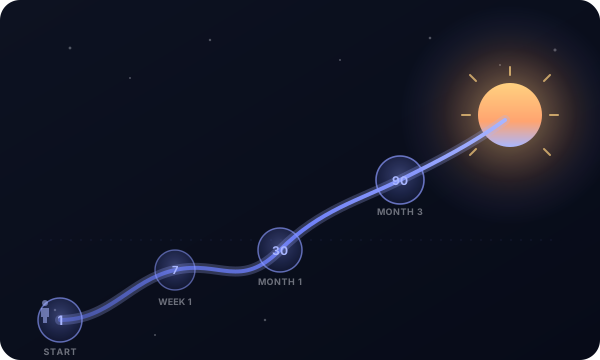
If you have opened this page, you have already done what thousands of people with a similar problem do not: you have acknowledged that something is wrong and are looking for information. This is not an «easy» admission – it is the first clinical step toward recovery. Every step described below is easier than the one you have already taken.
This page is not about «how to play more safely» (for that we have a separate Responsible Gaming section). This page is about what to do once «I have a problem» has been recognized: which types of treatment actually work, how to choose a specialist, what to expect in the first 30 days, how to support a loved one and where to turn today. All recommendations are based on modern clinical protocols and verified resources.
If you need help right now:
👉 1-800-GAMBLER – US National Council on Problem Gambling helpline, free, anonymous, 24/7. 0808 8020 133 – UK National Gambling Helpline (GamCare). If you are in acute crisis with thoughts of self-harm, call your local emergency number (911 in the US, 999 in the UK, 112 in the EU) and ask for psychiatric help.
1. Acknowledging the problem – the hardest step (you've taken it)
Anosognosia – denial of one's own illness – is not stubbornness or weak character but a clinical feature of the disorder itself. The brain of a person with gambling disorder defends against awareness via a set of automatic mechanisms: «everyone has it», «I can stop at any moment», «one big win and I'm done», «just a bad streak». If you caught yourself on phrases like that, you were fighting not yourself but a symptom.
Acknowledgment unfolds in two stages:
- Inner acknowledgment. Quiet, usually happens alone – often after another relapse, a major loss or a lie to a loved one. This is not enough for sustained recovery, but it's a prerequisite for the next step.
- External acknowledgment. Saying it out loud – to a person, a specialist, a support group. This step breaks the isolation that sustains the illness. Most clinicians agree that without external acknowledgment, self-recovery is unlikely.
Solo attempts to «push through with willpower» usually end in a return to gambling within 1–6 months. That doesn't make you weak – it speaks to the biology of the disorder described below. Understanding this matters for the next step.
2. What to know about the illness before searching for help
Gambling addiction is a neurobiological disorder rooted in a failure of the dopaminergic reward system. The same brain regions responsible for alcohol and psychostimulant dependence are activated by pathological gambling. This explains why a «decision to quit» by itself does not work – the decision is addressed to the prefrontal cortex, while the illness lives deeper, in subcortical structures.
Co-occurring disorders are present in 60–80% of patients with gambling disorder. Most often – depression, anxiety disorders, bipolar disorder, ADHD, and dependence on alcohol or psychoactive substances. Treating gambling alone without addressing these conditions usually produces unstable remission: anxiety or depression «pushes» the person back to gambling as a coping method.
The good news: gambling disorder is treatable. According to meta-analyses, cognitive behavioral therapy (CBT) shows 35–78% sustained remission depending on severity, co-occurring conditions and therapy duration. This is comparable to treatment efficacy for other addictions and significantly higher than for solo attempts.
3. Types of professional help: what actually works
3.1 Cognitive Behavioral Therapy (CBT) – the gold standard
CBT is the most studied and evidence-supported method of gambling addiction treatment. It's a structured, time-limited therapy, usually 12–20 sessions of 50–60 minutes. The therapist works with you on a specific plan:
- Trigger mapping. Identifying situations, emotions, people and signals that trigger the urge to gamble (boredom, an argument, push notifications, a specific place, payday).
- Environment restructuring. Removing apps, blocking sites, handing finances to a trusted person, changing routines – so that «don't gamble» doesn't depend on willpower in the moment of urge.
- Cognitive restructuring. Examining and refuting distorted beliefs: «I'm on a hot streak», «the next bet will recover», «I control risk better than others», «the casino owes me».
- Urge management techniques. «Urge surfing» – accept that the urge comes in waves, observe it without resistance and notice it subside within 15–30 minutes. Most urges, handled correctly, never turn into action.
- Relapse prevention. A plan of concrete actions for high-risk situations and slips.
3.2 Motivational Interviewing (MI)
Useful in early stages with ambivalence – «I should quit but I don't want to let go». MI is not persuasion or pressure; it's a conversation in which the therapist helps you articulate what you want from life and how gambling fits (or doesn't fit) in. It often becomes a «bridge» to CBT once motivation strengthens.
3.3 Family and couples therapy
Gambling addiction is never the illness of one person – it affects the entire family system. Family therapy helps to: rebuild trust after a period of deception, process loved ones' justified resentment, establish new boundaries (especially around finances), work through codependency. Often runs in parallel with individual CBT.
3.4 Group therapy and peer-support communities
«Gamblers Anonymous» (GA) is an international fellowship running a 12-step program similar to AA. Meetings are free, anonymous and open to anyone who wants to stop gambling. This is not clinical treatment but a powerful source of accountability, shared experience and community. Best outcomes come from patients who combine regular CBT with GA attendance. There are in-person meetings in most major cities worldwide and online meetings via Zoom.
3.5 Medication support
No medication is approved specifically to treat gambling addiction at this time. However, drug therapy is used to:
- Manage co-occurring disorders – SSRIs for depression and anxiety, mood stabilizers for bipolar, ADHD medications.
- Support sleep and reduce anxiety in the first weeks of cessation (short-term, under medical supervision).
- Naltrexone – an opioid-receptor antagonist that reduces urges – is being studied in clinical trials and used off-label in some clinics.
Medication is prescribed only by a psychiatrist or addiction specialist after an in-person visit. Self-medication with psychotropics is dangerous and counterproductive.
3.6 Inpatient treatment
Hospitalization is recommended when outpatient format is insufficient:
- Severe addiction with multiple failed self-quit attempts.
- Co-occurring alcohol or substance dependence.
- Acute suicidal behavior or ideation.
- Inability to create a safe home environment without access to money and gambling.
- Severe co-occurring depression or anxiety disorder.
A typical inpatient program runs 21 to 60 days. Transition to outpatient maintenance therapy after discharge is mandatory.
4. How to choose a specialist
The right choice of specialist has a major impact on outcomes. A few guideposts:
Who can treat gambling addiction:
- Psychiatrist. Medical degree + psychiatry residency. Authorized to prescribe medication and to diagnose by ICD-11 / DSM-5.
- Addiction medicine physician. A physician with additional addiction specialization. Particularly suited for co-occurring substance dependence.
- Psychotherapist. A psychiatrist with additional psychotherapy training. Combines medication and psychotherapeutic work.
- Clinical psychologist. A psychology degree (non-medical). Works with psychotherapy and support; does not prescribe medication. Can deliver CBT.
What to look for:
- Relevant education and experience. Ask how many years the specialist has worked specifically with addictions (not just «psychotherapy in general»).
- Certification in CBT or motivational interviewing. These are specific protocols taught separately from base psychotherapy training.
- A transparent treatment plan. At the first consultation the specialist should outline approximate duration, session frequency and expected stages. «Treatment depends on you, we'll see» is a red flag.
- Willingness to collaborate with other specialists. A good psychologist will, if needed, refer you to a psychiatrist for medication support, and vice versa.
Red flags – «methods» to avoid:
- Promises to «cure in one session» or «guarantee a result». Gambling addiction is a chronic illness that takes months of work. Guarantees are marketing, not medicine.
- «Coding», «implants» or similar one-shot procedures for gambling. Methods originally devised for alcoholism and in most cases not scientifically proven for behavioral addictions.
- Hypnosis as the sole or primary method. Can be an auxiliary tool in the hands of a trained clinician, but not a standalone therapy.
- Esoterics, «energy practices», «removing a gambling curse». Have nothing in common with treatment; dangerous because the person loses time and money while the problem progresses.
- Anonymous «clinics» without a medical license. In most jurisdictions, a license is mandatory for psychiatric / addiction medicine services – verify it before booking.
5. Roadmap: the first 30 days
This plan is a reference for those just starting the recovery journey. Specific steps may need adaptation to your situation, but the overall structure works in most cases.
Day 1 (today): stop the bleeding
- Activate self-exclusion at every casino and sportsbook you have used. On Duel it is done through the account dashboard or via support (24/7).
- Delete casino and sportsbook apps from your phone. Clear browser bookmarks. Enable blocking of these sites via a DNS filter or apps like GamBan / BetBlocker.
- Unsubscribe from all casino marketing emails, remove cashback notifications and push alerts.
- Call 1-800-GAMBLER (US) or 0808 8020 133 (UK) or book an initial consultation with a psychotherapist/psychiatrist.
Day 1–3: financial safety
- Hand financial management to a trusted person (partner, parent, close friend) – temporarily, for 30–90 days. This isn't «taking away freedom» – it's the equivalent of a cast on a broken bone.
- Block the «gambling» merchant category in your banking app (available at most modern banks).
- Lower the online-payment and transfer limits on your cards if they are high.
- Write down an honest list of all debts, including hidden ones, and discuss it with the person who became your financial-safety partner.
- Don't try to «hold on without help» – the first days after stopping carry the highest urge intensity and the highest relapse risk.
Day 3–7: first appointment, diagnosis, plan
- In-person meeting with the specialist. Bring honest information: when you started gambling, how often, what amounts, what you have tried, what co-occurring issues (sleep, anxiety, depression, relationships).
- Together with the specialist, formulate 3–5 goals for the next 90 days.
- Find the nearest Gamblers Anonymous group (in-person or online) and schedule your first meeting.
- Tell at least one trusted person that you are at the start of treatment. This breaks isolation.
Day 7–14: regular therapy and routine
- At least one CBT session per week.
- At least one peer-support meeting per week.
- Urge diary: what happened, when, at what intensity, how you coped. Material for the next therapy session and understanding your own patterns.
- Fill the «vacuum» – gambling took a lot of time and emotional energy; those hours and feelings now need to be redirected (sport, new skill, restoring relationships, walks – anything that brings at least small satisfaction).
Day 14–30: consolidation and check-in
- Work through deeper triggers: what exactly was gambling «numbing» – loneliness, anxiety, lack of fulfillment, a sense of not «being who you wanted to be»?
- Gradual return of some financial responsibility (in coordination with your partner and therapist).
- If a slip happens – do not treat it as a «course failure». Slips are part of the process for most patients. The important thing is not to «rewind» progress but to return to the therapist and discuss what happened. Slipping and continuing treatment is not the same as slipping and giving up.
6. Helping loved ones: support without codependency
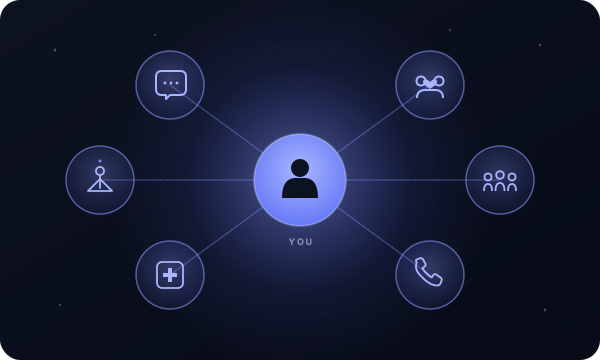
If this page is open because someone close to you gambles, you deserve dedicated support too. Addiction is a systemic illness, and codependent family members can suffer as much as the gambler.
What does NOT help:
- Control and surveillance. Checking the phone, hidden cameras, demanding «reports on every dollar» – short-term it can feel like you took back control, but it shifts the gambler's sense of agency to «being controlled» and weakens their own responsibility for recovery.
- Paying off debts «for the last time». Repeated «bailouts» sustain addiction: they remove one of the main consequences and reduce motivation to treat. This doesn't mean refusing all help – but help should be structural (e.g., paying for treatment), not patching holes from slips.
- Reproaches and ultimatums without follow-through. «If you gamble one more time I'll leave» said 10 times in a row becomes an empty threat and devalues all subsequent boundaries.
- Concealing the problem from other family members. Makes one person the «sole secret keeper», which is emotionally exhausting and maintains an atmosphere of shame.
What helps:
- Clear, pre-stated boundaries. «I will not pay card debts. I am willing to pay for treatment». «If gambling happens, we return to the conversation about separate finances».
- Emotional support without enabling the illness. «I love you and believe you can do this, but I will not pretend nothing is happening».
- Your own therapy and/or a Gam-Anon group – an international fellowship for loved ones of people with gambling addiction, on a 12-step model. It's not about «how to make them get treatment», it's about «how I don't fall apart next to this».
- Readiness for intervention. If your loved one categorically refuses help, in severe situations a formal family intervention with a specialist may be possible.
- Readiness for your own decision. In extreme cases, when someone refuses treatment for years and keeps destroying the family, physical and emotional distancing may be the only healthy choice. It is not betrayal – it is self-preservation.
7. What to expect during recovery
Recovery is a process, not a point in time. It helps to know its stages (the Prochaska & DiClemente «Stages of Change» model):
- Precontemplation. «I don't have a problem». Many people with addiction spend years here. If you reached this page, you are no longer at this stage.
- Contemplation. «Maybe there is a problem, but I'm not sure I'm ready to change anything». Lasts weeks or months. Motivational interviewing is especially useful here.
- Preparation. «I'm ready, figuring out how to start». Days to weeks. The ideal time to book a consultation.
- Action. Active phase of treatment, the first 3–6 months. The hardest period for urges, but also the most «concentrated» in terms of work.
- Maintenance. From 6 months onward. The active phase ends, but maintenance sessions (every 1–2 months) and the group continue. The goal is resilience to stressors that used to trigger gambling.
- Possible relapse. Happens to 30–60% of patients in the first year. It is part of the process, not «back to square one». Returning to treatment after a slip is the most important thing.
Average time to stable remission is 9 to 24 months of active work, followed by maintenance contact over several years. The «cured once and for all» concept does not apply to addictions; what we have is sustained remission in which a person lives a full life without gambling.
8. Where to turn: verified contacts
National helplines
- USA – National Problem Gambling Helpline: 1-800-GAMBLER – free, 24/7, anonymous. Call, text or online chat at ncpgambling.org.
- UK – National Gambling Helpline (GamCare): 0808 8020 133 – free, confidential, 24/7. Live chat at gamcare.org.uk.
- Australia – Gambling Help Online: 1800 858 858 – free, 24/7. Online chat and resources at gamblinghelponline.org.au.
- Gamblers Anonymous: a 12-step peer-support fellowship. Free, anonymous. In-person meetings in most major cities and online meetings via Zoom – schedule on the international organization's website.
International resources
- National Problem Gambling Helpline (USA): 1-800-522-4700 – 24/7 English-language helpline that refers callers to local clinics and programs.
- SAMHSA National Helpline (USA): 1-800-662-HELP (4357) – general line for mental health and addictions, 24/7, free, in English and Spanish.
- BeGambleAware (begambleaware.org) – leading UK resource: free 24/7 live chat, materials for patients and family members.
- GamCare (gamcare.org.uk) – UK National Gambling Helpline, forum, group support.
- Gamblers Anonymous International (gamblersanonymous.org) – international network of 12-step groups, meeting directory by country.
- Gam-Anon (gam-anon.org) – international support program for loved ones of people with gambling addiction, an analogue of Al-Anon.
9. If things are bad right now
This section is for an acute crisis: a strong urge right now, panic, thoughts of suicide or self-harm, the feeling of «I can't take this anymore».
If you have thoughts of suicide or self-harm:
👉 988 – Suicide and Crisis Lifeline (USA), 24/7, free, confidential. Call or text.
👉 116 123 – Samaritans (UK), 24/7, free, confidential.
👉 Call your local emergency number (911 in the US, 999 in the UK, 112 in the EU) and ask for psychiatric help. Emergency psychiatric services come for consultation and stabilization, not to «lock you away».
If the urge to gamble is overwhelming – the urge surfing technique:
- Notice it. Say it aloud or in your head: «I am experiencing an urge right now. This is normal at this stage. An urge is not a command to act».
- Breathe. Slow inhale for 4 counts, hold for 4, exhale for 6. Repeat 8–10 times. This activates the parasympathetic nervous system and reduces the impulse intensity.
- Set a timer. Most urges peak within 5–10 minutes and fade over 15–30 minutes if you do not «feed» them with actions (opening the app, checking balance, looking at odds).
- Do something physical. Step outside, shower, walk, push-ups, call a friend or a helpline. Any action incompatible with gambling breaks the pattern.
- Write it down. Where you were, what you felt, what preceded it, what helped. Every urge ridden out without a slip strengthens a new neural pathway and provides material for the next therapy session.
Key takeaways
✓ What works
- Acknowledging the problem + external help.
- CBT and motivational interviewing with a specialist.
- A peer-support group (GA) alongside therapy.
- Financial safety for 30–90 days.
- Treatment of co-occurring disorders.
- Clear boundaries and personal therapy for loved ones.
- Returning to treatment after a slip.
✗ What doesn't work
- «I'll do it myself, with willpower» – rarely sustainable without help.
- «Coding», implants, hypnosis as the sole method.
- Esoterics and promises to «cure in one session».
- Repeated debt bailouts by loved ones «for the last time».
- Control and surveillance instead of boundaries.
- Silence from shame – addiction lives in isolation.
- Treating a slip as a «failure» and giving up.
🔞 Access to Duel Casino is strictly for players 18 and over. This page is educational and informational in nature; it does not replace an in-person consultation with a psychiatrist, addiction-medicine physician or psychotherapist. If you see signs of addiction, seek professional help. Information on prevention and safe-play tools is available on the Responsible Gaming page.